

“Business success coach” (LOL), Derek Moneyberg, recently made big waves among the Brazilian Jiu-Jitsu community after earning his black belt in 3.5 years. If you’re unfamiliar with BJJ, this may not seem like a big deal; you probably know a few 10-year-old Karate black belts. However, a BJJ black belt typically takes around 10 years to achieve. Although there are cases of people receiving the belt on a timeline similar to Moneyberg’s, the difference is that they’ve proven themselves in high-level competition, whereas Moneyberg has never competed. Admittedly, he has assembled an Avengers-level team of coaches and trainers from the top echelon of MMA and BJJ competitors. But no one outside of these instructors, to whom he’s paying thousands upon thousands of dollars, has actually vouched for him.
The BJJ black belt is generally held in high regard, and in my non-expert opinion, it’s the most prestigious black belt in martial arts. I’d even argue that it–and to a slightly lesser extent, Judo—may be the only remaining black belt that signifies real skill and ability in addition to experience and knowledge (I’m open to changing my mind on this—feel free to educate me in the comments). Moneyberg argues that his 3,000 hours of individual training with the best in the game is the same as, or superior to, the ten years that a “normal” person would spend training in a gym a few times a week. But the general consensus among those not on Moneyberg’s payroll is that he paid for a belt and, in doing so, essentially took a big dump on the achievements of those who earned it the traditional way. This has cracked open larger philosophical debates about what a black belt actually represents. While I find these conversations interesting, the bigger question to me, as someone from the outside looking in, is how BJJ rank has held onto its prestige for so long when so many other disciplines started handing out black belts like candy years ago.
Helio’s Army

Simply put, it’s because BJJ is a cult. Okay, not literally (though people get suspiciously defensive whenever I joke about this). But it does trace back to Helio Gracie’s visions of breeding his own modern-day Samurai army, expedited through his secret practice of polygamy (I’m not joking this time). In his memoir Breathe: A Life in Flow, Rickson Gracie, Helio’s third son, highlights his father’s obsession with Bushido, the moral code of the Samauri. After adapting the Judo that they were taught by Mitsuyo Maeda into a new martial art, Helio and his brother Carlos aspired to create an army of Samurai warriors. They were serious enough about the idea that they felt the need to take multiple partners to birth more soldiers. Rickson notes, “My uncle and my father had the intention to create a clan of fighters and, in order to do that, they couldn’t be limited to one relationship and two or three kids.” He reveals that since Hélio’s wife Margarida was unable to bear children, Rickson and his two older brothers were conceived through their nanny, while Margarida wore pillows in public to appear pregnant. Officially, Helio fathered 9 children with 2 different women (the nanny and his second wife). However, because of the secretive nature of his “arrangements,” no one is exactly sure of the numbers. Even today, there continues to be controversy around people claiming to be a part of the Gracie lineage, with no proof one way or the other.
Rickson also discusses how, from a young age, Helio stressed the importance of real-world experience in addition to training. According to Rickson, street fights were not only common but encouraged, and he was often able to defeat larger and stronger opponents using his BJJ. These experiences reinforced the Gracie family’s belief in the superiority of their martial art. Beyond scrapping in the streets of Brazil, Gracies represented BJJ in “vale tudo” fights–organized no-holds-barred matches that would pit BJJ practitioners against fighters of different styles, from boxers and wrestlers to judoka. These fights served as a precursor to modern-day MMA and paved the way for the Gracies to further spread BJJ around the world.
The Ultimate Fighting Infomercial?
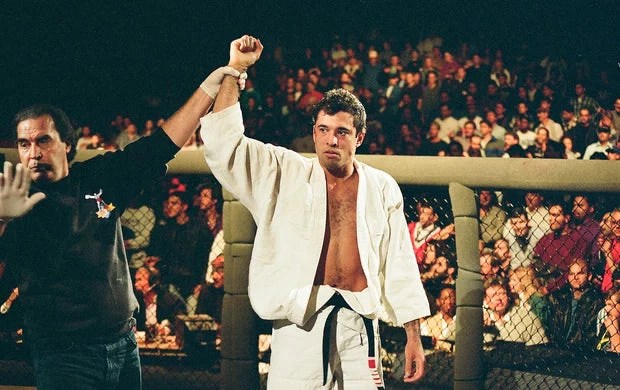
Today, social media abounds with debates about boxers vs. MMA fighters, legends beyond their prime vs. up-and-comers, and heavyweight influencers vs. lightweight champions. We’ve seen some of these experiments play out, but fight fans continue to be fascinated with hypotheticals. UFC 1, and eventually the sport of MMA, was born of similar questions. What would happen if a sumo wrestler fought a Muay Thai fighter? A karate practitioner vs. a boxer? If we lock two men in a room (cage) together, who comes out on top? Rorian Gracie and his partners decided that a vale-tudo-style tournament on a world-wide stage would be the perfect way to prove to the public that the answer was BJJ. Thus, The Ultimate Fighting Championship was introduced in 1993.
Although Rickson was considered the most talented of the Gracies, Rorian chose Royce to represent BJJ in the cage. Royce was the smallest of the Gracie brothers, so the optics of him winning the tournament against bigger, scarier-looking opponents would go further to prove the value of BJJ. When he successfully won by submitting Art Jimmerson (a professional boxer), Ken Shamrock (a shootfighter and wrestler), and Gerard Gordeau (a Savate and kickboxing champion), the effectiveness of BJJ could no longer be questioned. While the experiment was a huge success for the Gracies, critics were quick to suggest that UFC 1 was not the open experiment it claimed to be, but rather some sort of BJJ propoganda. Bill “Superfoot” Wallace, commentator for UFC 1, called the event “a two-hour advertisement for Gracie Jiu-Jitsu.” He recalls having “a guy sitting beside me… telling me what to say about the Gracies” and claims that Rorion hand-picked “six strikers, Royce, and a sumo wrestler.” In other words, no one who could defend takedowns. He also said that “the other guys couldn’t even wrap their hands… but Royce was allowed to wear the uniform.” Ken Shamrock similarly claimed that he was forced to remove his wrestling shoes minutes before their match. Wallace went on to say that he was never invited back because he “asked too many questions.” Even Art Davie, the UFC’s co-founder, has acknowledged that the Gracies heavily influenced the matchmaking and format, presumably designing the event to highlight BJJ’s strengths. Conspiracy or not, UFC 1 more than cemented Brazilian Jiu-Jitsu’s legacy as a truly legit martial art. Furthermore, it began to steal some thunder from the ubiquitous Karate and Taekwondo dojos left over from the martial arts boom of the eighties. BJJ had officially begun its transformation from a niche Brazilian martial art to an essential part of a fighter’s toolkit.
Conclusion
So, back to my original question: why does a BJJ black belt still carry so much weight? From the beginning, it’s taken more than just mat time and paying gym dues to thrive in the Gracie world. Helio built not only a combat system, but a quasi-religion, raising his kids like little hybrid samurai-monks who would choke out strangers in the street just to prove a point. Though he and his family may have been somewhat deranged, or perhaps because of that fact, they made sure a BJJ black belt actually meant something. I don’t have a dog in this fight, but it’s easy to see why the idea of Mondeyberg’s promotion after a few years of private lessons has serious practitioners sounding the alarm bells to a potential era of BJJ McDojos on the horizon.

References
“3.5-Year BJJ Black Belt Derek Moneyberg Fires Back at Haters: ‘I’m a Legit Black Belt. Haters Are Jealous of My Success.’” Bjj Eastern Europe, 10 July 2025, www.bjjee.com/articles/3-5-year-bjj-black-belt-derek-moneyberg-fires-back-at-haters-im-a-legit-black-belt-haters-are-jealous-of-my-success/.
Davis, John. “Moneyberg Says He Spent 3,000 Hours Just Thinking about BJJ to Justify Odd Promotion.” BJJDOC, 23 July 2025, bjjdoc.com/2025/07/23/moneyberg-says-he-spent-3000-hours-just-thinking-about-bjj-to-justify-odd-promotion/.
Davis, John. “UFC Founder Talks How the Gracie Family Shaped Matchmaking at Early Events.” BJJDOC, 14 Dec. 2024, bjjdoc.com/2024/12/14/ufc-founder-talks-how-the-gracie-family-shaped-matchmaking-at-early-events/.
Enkamp, Jesse. “ The Gracie UFC Conspiracy.” YouTube, 4 Aug. 2019, www.youtube.com/watch?v=I_tMkWoUN18.
Gracie, Rickson, and Peter Maguire. Breathe: A Life in Flow. Dey St., an Imprint of William Morrow, 2021.
“The Great Gracie Hoax: Rodrigo ‘Gracie’ Jr.. Admits His Real Name Is Da Silva – despite Years of Support from Renzo Gracie.” Bjj Eastern Europe, 7 July 2025, http://www.bjjee.com/articles/the-great-gracie-hoax-rodrigo-gracie-jr-admits-his-real-name-is-da-silva-despite-years-of-support-from-renzo-gracie/.
 The Casual Combatants
Leave a comment