
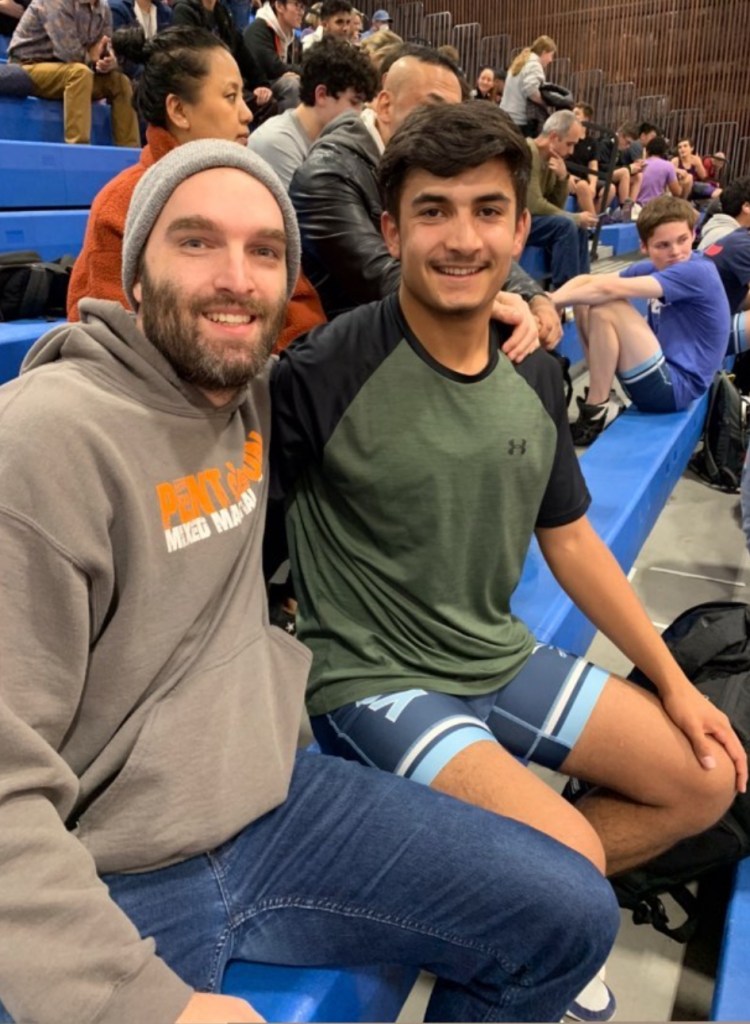
Shuaibullah Mansory stood in his wrestling singlet on the hardwood floor of the gym, completely locked in and chomping at the bit to face his opponent. He exuded confidence and looked ready for war, when suddenly I snapped him out of his trance.
“Where’s your headgear?” I asked him.
He had forgotten it—a rookie mistake. I sprinted to where the Yorktown High School wrestling team was sitting and found someone who had just finished their match.
“Hey man, can Shuaib use your headgear?” I asked the random teen.
I darted back across the gym and made the delivery to my student, who was preparing to walk onto the mat for his highly anticipated match.
As he fiddled with the sweaty headgear, the assistant coach approached him. “Get your body warmed up,” she instructed.
Shuaib stared at her, confused.
“Umm, do this,” she said, demonstrating a variation of a jumping jack.
He gave a thumbs up and started working up a mild sweat until his weight class was announced and the coach gave him the go-ahead.
He put on a sloppy showing in the first round, but when the whistle blew to begin the second, he instantly shot for a single-leg takedown and secured a pin within thirty seconds. The large crowd that had gathered for him–his brother, uncle, many cousins, and me–went crazy, erupting in cheers as he stood up and flexed his biceps in triumph. He wasn’t the state champion. He hadn’t won a big tournament. This was his first match–a freshman JV scrimmage against an opponent who was also new to the sport. But to Shuaib and his family, it was more than just a wrestling match. The victory was symbolic; they were finally winning in life.
Shuaib was fourteen when the US military officially withdrew from Afghanistan in 2021, resulting in mass chaos and a swift takeover by the Taliban. While his immediate family was far away from the city in their small village, he was living with his uncle in the capital, Kabul, to attend school. His life was instantly turned upside down as he found himself among the thousands of Afghans trying to flee the country before the Taliban tightened its grasp. Multitudes of people gathered outside the Kabul airport in desperation, many of whom had cooperated with the US military and were fearful for their lives. Shuaib’s cousin in the US–who had at one point fought against the Taliban alongside US troops–reached out to contacts in the military, who agreed to help get the family out of the country. But they would all have to make it inside the airport, which was virtually impossible. In addition to the huge crowds blocking the gates, Taliban soldiers guarded the perimeter. At one point, soldiers fired shots at members of Shuaib’s family and struck his cousin with the butt of a rifle. Their efforts to enter the airport were starting to seem in vain, but after three days of trying, the sixteen family members were finally able to make it through a gate to meet up with the Marines that were expecting them. They were put on a cargo plane full of other refugees and sent to the United Arab Emirates. Shuaib, however, was not on the plane with his family; he was lost in the crowd surrounding the airport.
For two nights, he slept outside by himself until he was finally able to make his way through a gate. Luckily, he had a phone and could communicate with his cousin in the US, who helped him meet up with the right people once he made it inside the doors of the airport. He was taken to a hangar where he fell asleep until, at some point, a man woke him up to let him know that a plane was leaving and he needed to get on. He would later learn that soon after he made it out of the country, a terrorist suicide bomber murdered 170 Afghan civilians and 13 US military members at Abbey Gate, where some members of his family had tried to enter the airport earlier in the week.
Shuaib arrived at the refugee camp in Abu Dhabi and asked around until he found his cousins, uncle, and older brother. They were happy to be reunited, but soon hit another roadblock–while waiting for paperwork to go through so that they could go to the US, there was a measles outbreak. This, on top of the ongoing COVID-19 pandemic, kept them from leaving the camp. They remained in this state of limbo–never knowing when or if they would be able to leave–for nine long months before being sent to Leesburg, Virginia, for processing. After yet another month of uncertainty, Shuaib and his family finally arrived at their new apartments in Arlington, Virginia, on June 27th, 2022.
That September, he walked into my English classroom as a high school freshman. Like many of my students who arrive from other countries, Shuaib showed up somewhat apprehensive and anxious. Unlike my other students, however, he didn’t have any friends in class who spoke his native language. In fact, he was probably hearing more Spanish than anything throughout the day, which was detrimental to his efforts to learn English. Despite these frustrating circumstances, he always came to class with a positive attitude and tried his best to befriend his classmates.
After a couple of months in my class, he approached me about winter sports tryouts. He was interested in playing basketball, although he had never played on an organized team before. I explained that if he was determined to play basketball, then he should try, but that getting a spot on the team would be very competitive. I thought about how, with the help of Google Translate, we had spoken here and there about MMA. He was a fan of Khabib Nurmagomedov, Islam Makhachev, Khamzat Chimaev, and other famous Muslim fighters, and had a brother who kickboxed in Afghanistan.
“Have you considered wrestling?” I asked. “There are no tryouts. Do you know what that word means? Tryouts? Everybody makes the team. You’re a strong kid–I think you could be really good.”
I lifted my arms and flexed, then pointed to him to make sure he understood what I meant.
“Check this out,” I said and had him come behind my desk while I opened up a video of Olympic wrestling highlights on YouTube. His eyes lit up and he smiled as he watched an Olympian lift his opponent into the air. Soon, we were shopping online for wrestling shoes.
I checked in on Shuaib at practices periodically and attended most of his JV meets that first year. I would sit with him in the bleachers and offer him unsolicited advice as he prepared for his matches, never knowing if he was even understanding what I was talking about. This extended to our teacher-student relationship; we discussed nutrition and exercise during class, and I bought and assigned him children’s books on wrestling to read at home. I was so present that year that at one point, a couple of confused JV wrestlers asked me if I was an assistant coach. This was possibly to the annoyance of the real coaches who were actually qualified to teach him about the sport. However, I was sometimes used to assist with language-related matters. While his English was rapidly improving, Shuaib’s lack of comprehension and incomplete understanding of the rules more than once landed him in hot water with the referees.
At one early match, he hit a double leg takedown (which had become his go-to move at this point), lifting his opponent high in the air before slamming him forcefully to the mat like some sort of WWE move. The crowd let out a collective “oof” and the ref immediately blew the whistle and checked on the kid who got slammed. Shuaib looked around, confused. He thought he had done something really good and couldn’t understand why he got stopped. He stared blankly at the ref who was chastising him until the coach walked onto the mat.
“He doesn’t really understand English,” the coach said.
“He can’t do that!” the ref emphasized.
The coach tried to explain to Shuaib that he had to maintain control and not use excessive force if he was going to slam someone, but Shuaib struggled to understand.
“So I can’t pick them up?” he asked in his broken English.
“You can pick them up, you just have to control them on the way down. No slamming them hard.”
More confused looks. The coach tried to explain again, but Shuaib just wasn’t getting it. The ref looked impatient, and in desperation, the coach called me over from my spot beside the mat and indicated for me to try and explain. I jogged confidently to the center of the mat as if I could easily translate, before remembering that I knew the same amount of Farsi as the coach–none. I engaged my ESL teacher superpowers and somehow got something to click. From that point on, Shuaib would often lift his opponents in the air before gingerly laying them onto the mat. I imagine the guys would have preferred to be slammed down, as this seemed very emasculating, but Shuaib was not going to risk losing points.
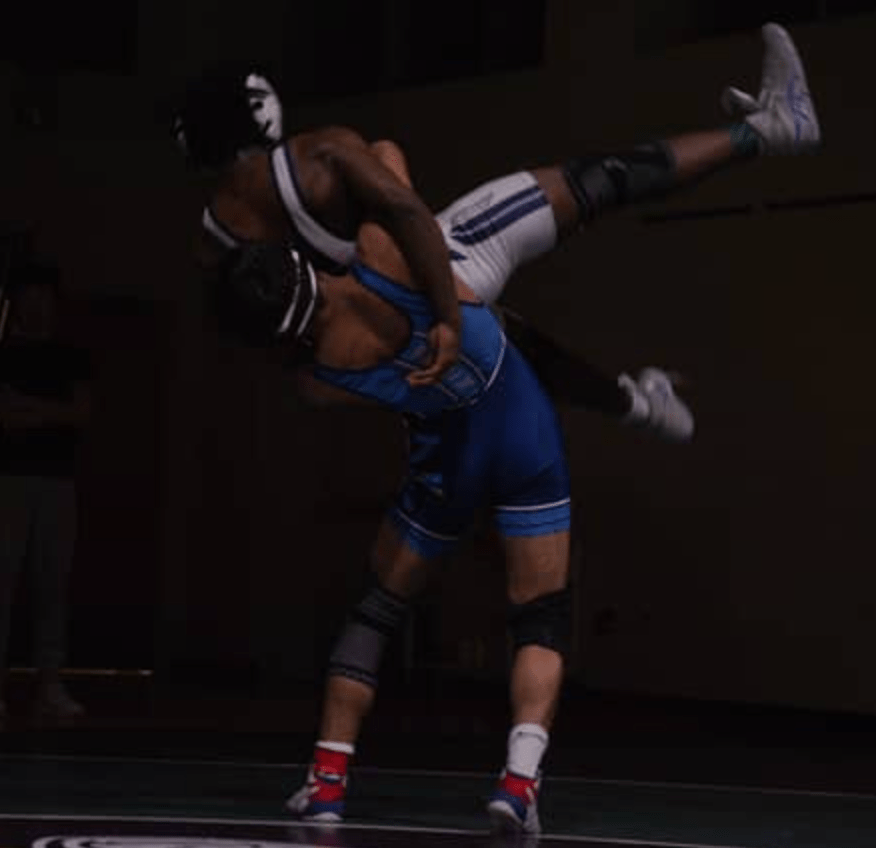
There were other growing pains that he had to work through. At another of his freshman matches, his headgear kept slipping off his ears and onto his face. Constantly having to adjust it was seriously messing up his game, and his opponent was taking full advantage. Agitated, Shuaib eventually ripped the headgear off, threw it to the side, and got into his stance, ready to continue the match. Problem solved. The ref blew the whistle to stop, and a very irritated Shuaib threw his arms up and looked at his coach in frustration.
“You gotta wear it,” the coach said.
“It’s okay, I don’t need it,” Shuaib protested while indicating with his hands that it was blocking his vision.
“We’ll adjust it later,” the coach said. “You gotta wear it.”
Someone retrieved the headgear, and Shuaib put it back on. Visibly annoyed, he hit his signature double leg, and the headgear immediately slid to the side, covering both of his eyes. Blinded, but eager to finish the match, he continued wrestling by listening to the directions that his older brother, Shams, yelled in Farsi. He pinned his opponent, stood up, and removed the cursed headgear. His arm was raised, and he finally let out a small grin before shaking hands with the other wrestler and opposing coaches. He went on to make adjustments and have an overall successful freshman year. He won some and lost some, but was constantly learning and improving, both in wrestling and school.
“[Wrestling] was difficult at first. Everyone was speaking a different language, and I didn’t know anyone. But when I learned the moves and made friends, it got easier,” Shuaib told me recently.
I asked how he was able to learn moves if he didn’t understand anything.
“I just watched what other people did and copied it,” he said.
The friends he made on the wrestling team went out of their way to help him, and that’s when I started noticing big differences. Not only did his English improve by leaps and bounds, but he seemed much more comfortable and confident. His friend group expanded, he excelled in class, and he always had a smile on his face.
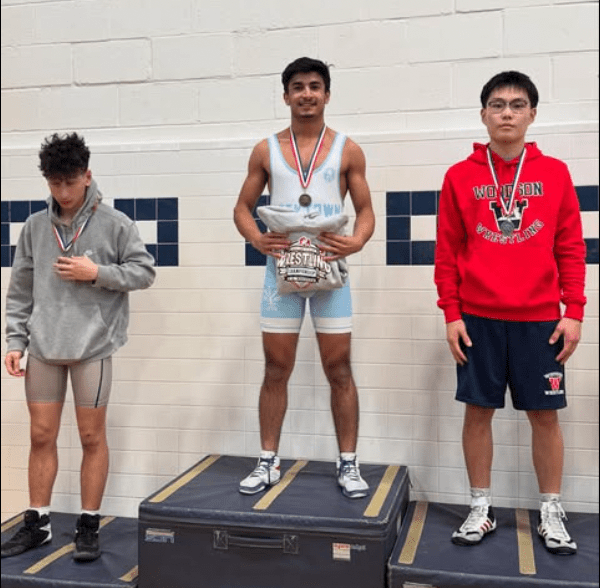
He started his sophomore year with a strong grasp of the language and better wrestling technique, along with a more complete understanding of the rules. I didn’t stop by practice or go to every meet anymore, but I always watched videos of his matches and kept up with how his season was going. He got a few varsity matches under his belt and faced some tough competition from kids with years of experience who wrestled year-round in clubs. This set him up for a successful junior campaign, which he finished this year. He ended with a winning varsity record, placed first in one of his tournaments, and made a deep run at regionals, where an injury forced him to exit one win short of qualifying for states. I only made it to one of his matches, but it was a special one; it was the first time his mother and father got to see him wrestle in person, as they had just made the journey to the US with his younger brother.
Since Shuaib showed up in my class his freshman year, other Afghan refugees have trickled in. He’s done his best to make the transition easier for them, starting an official Afghan Culture club and getting three fellow Afghans to try wrestling (though it didn’t speak to any of them in the same way it did for Shuaib). While his journey to the US was anything but normal, he now feels at home as he balances work, school, and a social life in the same way as any other typical teen.
“The focus next year is states, then wrestling in college,” he told me recently when I asked about his plans for senior year.
Within only a few years, Shuaib has gone from fleeing the Taliban and being in a refugee camp to finding stability, purpose, and direction. Without wrestling, he says he’s not sure it would have gone that way. What started as a way to socialize and acclimate to his new environment has become his path going forward in life.

 The Casual Combatants
Leave a comment