
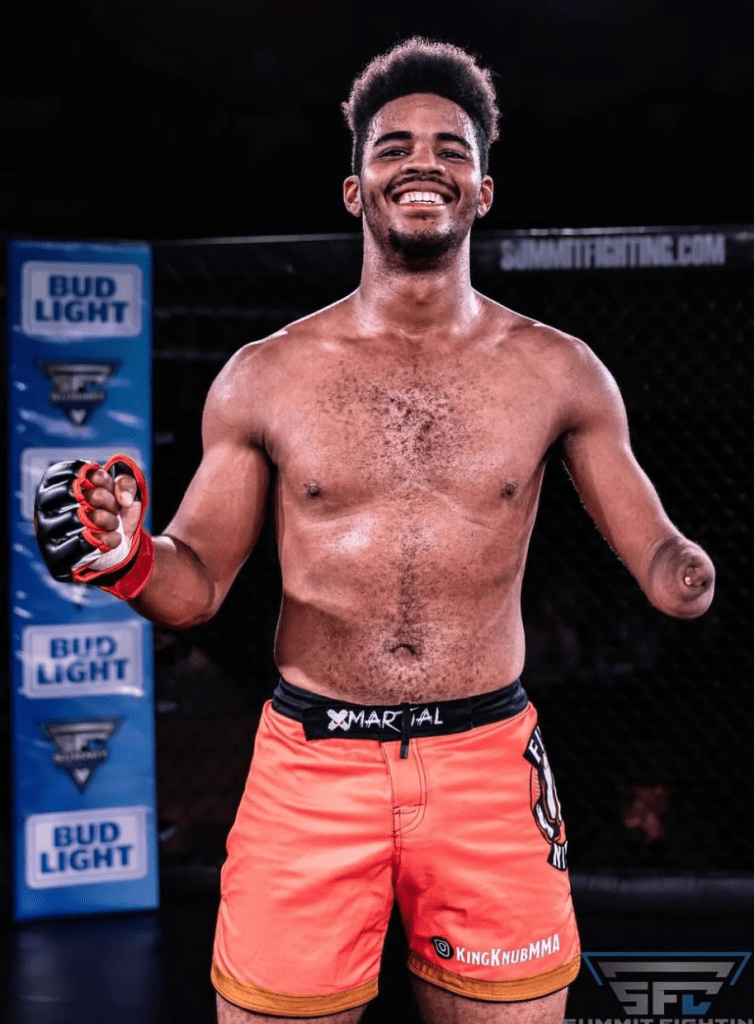
One day in January 2024, I was enjoying my holiday break from teaching, lying lazily on my in-laws’ couch and doom scrolling Instagram. The algorithm led me to a video of an MMA fighter who only had one arm knocking out his opponent. I glanced at the comments and saw “hey, I’m a one-armed fighter, too!” This is how I discovered Reggie “Kingknub” Amerson. I clicked on his profile and to be honest, my interest wasn’t initially piqued so much by his lack of a left forearm as the picture of him with controversial UFC fighter Bryce Mitchell and the caption mentioning he lived in Arkansas. I scrolled to check out some of his other pictures and saw a video of him working out with a BOB punching bag while dressed neatly in a white shirt and tie. At the bottom of the post I noticed the hashtag #lds, confirming my suspicions that I was looking at a fellow Mormon. I paused and took in the fact that I had found a one-armed, MMA-fighting Black Mormon living in the Bible Belt. I may as well have discovered Bigfoot.
I don’t make a habit of talking to strangers on social media, but I had to make an exception here. I commented on the video, told him that I’d stumbled on his page randomly and I’d definitely be following his career. He responded to my comment thanking me and I let him know that if he ever found himself in the DC area, I’d be down to get in some training together. True to my word, I’ve been keeping up with his activity since then. He currently holds a perfect 3-0 amateur record with three first-round finishes. When I saw the first round TKO highlight from his third fight– a front teep to the stomach that sent the guy flying backwards and to the canvas, followed by a devastating hammer fist–I determined that more people had to know about this man. I reached out to ask Reggie if he’d be open to an interview and having me write a profile on him.
When we Facetimed, he was in his car, on a break from his IT job where he works on computers, servers, and Wifi networks. He mostly sits all day and just monitors things; a far cry from the lights and adrenaline of fighting in a cage. To begin the conversation, he told me that he’s a husband and a father, and how important his family is to him. He gushed as he talked about his three kids and how excited he was for his oldest son’s birthday next week.
“That’s what fighting is about for me,” he said. “I love fighting, it’s my passion, but I really want it to work out so I can provide a better life for them. The better I do, the better off they will be.”
Although his career is in its infancy, Reggie has been training off and on since he was thirteen. His dad and brothers were big MMA fans, so he grew up learning about Anderson Silva and other fighters of that era. Apart from coming up in a family of fight fans, his cousin was a fighter and they were able to train together often. Despite having this early exposure, Reggie wasn’t able to get his first fight until his mid-twenties. While he wanted to start taking fights much earlier, due to moving between states and other life circumstances he wasn’t able to settle in and commit to training and fighting on a regular basis. He intends to make up for that now by being as active as possible. His first three fights all came within a year of each other, in addition to two fights that he prepared for, only to have his opponents pull out last minute.
In preparation for our call, I found and watched his debut fight on Youtube. One of the first things the commentators pointed out was that Mississippi, where the fight took place, is the only state in the US where amateurs fight under the same rules as professionals. His first time in the cage and knees and elbows to the head were fair game. The bell rang and Reggie immediately walked to the middle of the cage and got into a firefight. He took hard shots to the face, but kept pressuring his opponent, throwing big crosses, hooks, and knees. His opponent engaged him in the clinch and Reggie landed a couple of good knees to the body before taking him down with a Judo-style trip. The fight went back to the feet and the two took turns controlling each other against the cage, before ending up back in the center. Reggie shot a double-leg, taking it back to the ground. From there, the two exchanged punches and elbows until the opponent gave up his guard and attempted to bring the fight back to the feet. Reggie latched on and ragdolled the guy to the canvas, throwing in some ground and pound before taking his opponent’s back and sinking in a rear-naked choke. The opponent tapped and it was over in less than three minutes.
One of the things I was looking for in the fight was to see how Reggie would go about defending strikes to the head with only one hand. He didn’t, really, which I brought up when we spoke. I told him that he seemed to just use his chin to block shots, only realizing afterwards that I probably sounded like a jerk. He was a good sport, though, and laughed at my critique.

“I actually have sound technique,” he assured me. “I just wasn’t focused. Everything went black in that first fight, man. In sparring everything looks super clean. I have certain techniques for how to block head kicks, overhands, pulls, counters. I swear I have it, but if I don’t stay focused I end up relying on my chin.”
He knows he can’t expect that to save him as the level of competition increases.
“Fortunately for me, I’m not the first one-armed guy to want to do this kind of stuff,” Reggie told me.
Seeing one-armed fighters thrive at the highest level of the game has not only given him the confidence to know that he can do the same, but also given him a template that he can study and implement into his own game.
“I watch Jake Peacock’s muay Thai and Nick Newell’s grappling, and seeing how they do it helps me understand more how I can put together techniques for myself and fight the best I can. I see Nick work submissions and I’m like ‘I’ve never thought of that before.’ And Jake, I definitely try to mimic his clinch work.”
Reggie got a big surprise one day when he opened Instagram to see one of his reels shared by one of these inspiring figures, Nick Newell. “This guy’s a bad-ass!” read the caption. It seems somebody at Nick’s gym had showed him Reggie and he was impressed. They’ve been in contact since then and Reggie is planning a trip to Connecticut this year to train at Nick’s gym.
When I watched Reggie’s second fight it was quite different from his debut. To begin, it took place in Tennessee, meaning knees and elbows were not allowed. While this rule change would usually affect both fighters equally, in Reggie’s case, it was a huge disadvantage; his “knub” is considered an elbow by the athletic commission, limiting his striking to only his right hand. I instantly knew it wouldn’t matter, however, when I saw his opponent enter the cage. Apparently, the guy had taken the fight on three days notice and driven from Missouri. He was a pale, skinny kid who even soaking wet could not have actually been a welterweight. With his poorly done confederate flag arm tattoo and deer in the headlights facial expression, he looked like he had gotten lost on his way to a Streetbeefs fight and wandered into the cage with Reggie. The ring announcer introduced “Knub King,” and the fight began. Reggie started with a quick low kick that connected, sweeping his opponent and sending the fight to the canvas. The kid used all his energy to barely make it to his feet, only to be showered with a barrage of heavy shots that forced the ref to stop the fight at 1:30. Reggie looked at the crowd and threw his arm up as if to say “is that all?” Rather than happy, he looked frustrated. He walked back to the center of the cage and whispered something to the announcer, presumably telling the guy to get the name right. Reggie “Kingknub” Amerson was announced the winner and took his opportunity on the mic to voice his frustration at the lack of quality opponents willing to face him.
“Come on, man, be real. You want a chance to beat me, you’re gonna need more than three days,” he told the audience.
In our conversation, Reggie elaborated on how much trouble he has getting fights. In his opinion, it all comes down to fragile egos. Even if he’s a good fighter and a legitimate threat, people don’t want to risk losing to a one-armed fighter. In their minds, if you beat a guy with one arm no one thinks anything of it because it should be easy. You lose to a guy with one arm, you must really suck. Reggie, whose Instagram is filled with posters of fights that never happened, just wishes people wouldn’t book fights in the first place if they’re only going to back out. Even as he was speaking about it on the phone, I could tell that the subject struck a nerve. He feels like other fighters are constantly disrespecting him.
“I’d be pissed about a loss regardless,” he said. “Who cares who it’s to. Just because I’ve got one hand doesn’t mean it’s a lose-lose for you. Get that garbage out of your head. I can whoop you. And if you do beat me, it means you’re a good fighter.” He continued, “if I break into your house to rob you, you’re not gonna let me go because I have one arm. Well I’m in the cage to take your money, so you better come try to beat me up.”
I shifted the conversation by asking Reggie if he thought his disability offered any competitive advantages. While I was somewhat apprehensive to ask this question for fear I might sound like an idiot, his answer was a resounding “definitely!”
“Fight prep is easy for me,” he said. “I can train for all different styles every day. You can’t train for a guy who has a knub if you don’t have a guy at your gym with a knub.”
He went on to explain that his missing limb also eliminates the threat of certain submissions because there’s no wrist on that arm for his opponent to control. Additionally, due to its short length, there are certain things he can do in the clinch with his “knub” that his opponents can’t do with their arms. Rather than trying to compensate for a shortcoming, he looks at his “knub” as an asset and incorporates the advantages into his gameplan.
Besides fighting in the cage, Reggie has been doing Taekwondo for about seven years and competes at the highest level for Team USA Para Taekwondo. When I asked him about this, he said “oh, yeah,” almost as if competing on the world’s stage was an afterthought. Like most aspects of his life, he didn’t take a traditional path to Taekwondo competition. While many MMA fighters begin their journeys taking martial arts as kids and eventually transition to full contact fighting, Reggie was introduced to Taekwondo at the age of eighteen through someone at the MMA gym where he trained. One of his instructors, a military veteran who lost his arm in combat, had competed for Team USA and approached Reggie about trying it out. So, Reggie never learned kata or other traditional aspects of the art, but rather went straight into sparring and competition. In the last seven years he’s competed for Team USA many times and has already qualified for the 2028 Paralympics in Los Angeles. To be honest, as he was telling me all of this, he didn’t have nearly the same excitement in his voice as when he talked about his first MMA fight, which he said gave him such a high that despite being completely exhausted he could have fought three more people. A huge Olympic and Paralympic fan, I pressed the subject and asked him if he had dreams of Olympic gold.
His response? “I’m not sure yet. Taekwondo is fun, but it’s point sparring. I wanna knock people out or choke them.”

He’s not joking. Team USA has a tournament coming up next month in Brazil, but Reggie is skipping out on it because he has a fight in the works during that time. I couldn’t believe it when he told me this. He is really giving up a trip to Brazil for an amateur MMA fight in Arkansas.
But Reggie’s thinking long term. His plan is to fight for the Attitude MMA welterweight amateur belt. This is the biggest MMA promotion in the region, which hosts both amateur and pro fights as part of the LFA network. The LFA is one of the biggest feeders into the UFC, with former champions including Kamaru Usman, Sean O’Malley, Alex Pereira, Valentina Shevchenko, and many more. Besides all of the pro fighters and coaches in attendance at his fight, it will be streamed on UFC fight pass. This will definitely be a step up in both competition and exposure, and Reggie is determined to use the opportunity to put on a memorable performance that will make an impact. His opponent may be more experienced and technical than the people he’s fought so far, but he’s excited for the challenge and confident he’ll be prepared to break the guy down.
Challenges are nothing new for Reggie. In fact, he’s been using his strength to overcome adversity since he was in the womb, when his umbilical cord became wrapped around his neck. Rather than letting it suffocate him, a not-yet-born Reggie used his left hand to perform his first ever choke escape, working the umbilical cord off of his neck. Unfortunately, the cord then wrapped around his arm, which eventually detached completely. The arm began regenerating, but only got to a certain point before he was born with his signature “knub.”
“So I was born with one arm instead of being headless. That’s a win!” he quipped.
He came into the world on a win, and is looking to keep the wins coming. The first step is putting on a good show and getting the Attitude MMA welterweight belt on May 31st.
To end, I asked Reggie if he was worried at all about always being “The One Armed Fighter,” especially with it being referenced in his fight name. He explained that Reginald comes from the Latin for “king,” and his “knub” is how he was born and therefore a part of him. So in a way, his moniker is about being true to who he is. He doesn’t mind being known for having one arm. In fact, he appreciates the marketing value; He’s easily recognizable and people will remember him. More importantly, though, maybe someone will see him as a source of inspiration one day, like other athletes have been for him. At the same time, he would ultimately like to be appreciated for his talent and merits as a fighter, regardless of how many limbs he was born with.

“In an odd way, fighting brings me peace.”
-Reggie Amerson
“It’s kind of a double edged sword, I guess.” He said. “Maybe one day I’ll have to change my name or something.”
For now, though, “Kingknub” is here and ready to take his throne as one of the greats.
Links:
LFA Fight Network (Stream Attitude MMA Fights)
*Reggie wishes to thank Nick Newell and Jake Peacock for being such massive inspirations, as well as his two coaches Nolan Smith and Mitchell Dunn for being “amazing and awesome to work with.”
 The Casual Combatants
Leave a comment